




As of January1, 2020, the tax treatment of Bonus Shares is described below; please note that this is subject to change.
Terms beginning with a capital letter have the meanings assigned to them in the Free Share Plan set forth in Exhibit 1 to the grant letter, unless otherwise defined in the text below.
Holders of Bonus Shares may receive two types of gains:
- The Vesting Gain, equal to the value of the Bonus Shares on the date of their definitive grant, i.e., at the end of the Vesting Period (referred to as the “Vesting Date”)
- Capital Gain on the Sale of Bonus Shares, equal to the difference between the sale price of the Bonus Shares and the Acquisition Gain
Please note that the benefits of the Bonus Share Plan are not compatible with those of the Stock Savings Plan (PEA).
TIMELINE FOR THE TAXATION OF BONUS SHARES
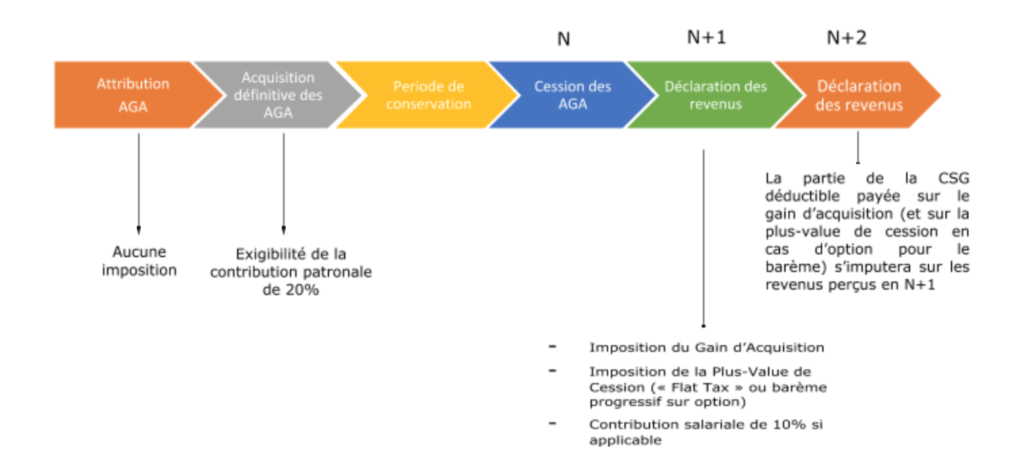
TAXATION OF CAPITAL GAINS
Taxes Payable by the Beneficiary
Capital gains are subject to the progressive income tax schedule for the year in which the said Bonus Shares are sold (Articles 80 duodecies and 200 A of the General Tax Code) under the following conditions:
- Portion of the Capital Gain not exceeding €300,000
This first portion of the capital gain is subject to the progressive income tax schedule. The single flat-rate withholding tax (or “flat tax”) does not apply.
For the purposes of calculating income tax, the capital gain is reduced by a 50% deduction regardless of how long the securities were held.
Under certain conditions, a fixed deduction of €500,000 may also apply if the Bonus Shares are sold by an executive who is retiring.
In addition, this first portion of €300,000 of the capital gain is subject to social security contributions (on investment income) at an aggregate rate of 17.2%, calculated on the full amount. This is because the 50% deduction does not apply to the base for social security contributions.
The deductible CSG is proportional to the amount of the capital gain taxed at the progressive tax rate. Thus, in principle, the deductible CSG is 6.8% of total social security contributions, which amount to 17.2%. However, this deductible portion is reduced by half—resulting in a deductible CSG rate of 3.4%—to account for the application of the allowance used to calculate the capital gain subject to income tax based on the capital gain.
A portion of the General Social Contribution (CSG) included in social security contributions may be deductible from the total taxable income received in the year the CSG is paid. In practice, the CSG will be applied to the income received in the tax year in which the capital gain is actually realized.
- Portion of the Capital Gain Exceeding €300,000
This portion is subject to income tax at the progressive income tax rate without any deductions, plus social security contributions at a rate of 9.7% (social security contributions on earned income).
The CSG is deductible from taxable income in the amount of 6.8% of the total 9.7% in contributions.
In addition, the beneficiary is liable for an employee contribution of 10 percent, calculated on that portion of the capital gain exceeding €300,000. This contribution is collected in the same manner as social security contributions, meaning it is paid at the same time as the income tax and social security tax assessment notice is received.
Taxes Billed to the Company
The company issuing the Bonus Shares is liable for an employer contribution regardless of the amount of the Acquisition Gain.
This employer contribution is based on the value of the shares as of the Acquisition Date at a rate of 20 percent.
As an exception, the portion of the Acquisition Gain that does not exceed, per employee, the annual Social Security ceiling (€41,136 for 2020) is exempt from the employer’s contribution. This limit is calculated by aggregating the free shares that vested during the current year and the three preceding years. To qualify for this exemption, the Company must meet the following conditions:
- It has not paid any dividends since its inception through the date of allocation of the Bonus Shares
- It meets the EU definition of an SME (thresholds: fewer than 250 employees and total assets not exceeding €43 million or annual revenue not exceeding €50 million)
- It is subject to corporate income tax (IS),
Above this threshold, the Acquisition Gain is subject to a 20% employer contribution.
The contribution must be paid in the month following the date on which the beneficiary acquired the shares.
In the event of non-compliance with the conditions related to the Vesting Period and/or the Holding Period, the Vesting Gain is treated as salary and is therefore not subject to the 50% tax deduction. It is then taxable in the year in which the Final Vesting Date occurs, rather than in the year the Free Shares are sold. This failure to comply with the conditions also results in the application of employer and employee social security contributions to the Vesting Gain at the rates applicable to wages.
TAXATION OF CAPITAL GAINS ON THE SALE OF PROPERTY
Taxes Payable by the Beneficiary
The capital gain on the sale—that is, the difference between the sale price of the Bonus Shares and the acquisition cost—is subject to the single flat-rate withholding tax (PFU) of 30%.
This tax rate includes both income tax (at a rate of 12.8%) and social security contributions (at a rate of 17.2%).
No deduction applies when calculating the capital gain on the sale, except—under certain conditions—when the executive retires. In the latter case, both the capital gain on the sale and the acquisition gain may be reduced by a fixed deduction of €500,000.
The CSG paid on capital gains from the sale of property may not be deducted from the taxpayer’s income, unless the taxpayer elects to have the capital gain taxed at the progressive income tax rates.
Taxes Billed to the Company
In the event of a transfer of Bonus Shares, the Company is not subject to any tax liability.
REPORTING REQUIREMENTS
Disclosures to Be Made by the Company Following the Grant of Bonus Shares
The Issuing Company, as an employer, must notify its collection agency (Urssaf) the names of its employees or corporate officers to whom Free Shares were granted during the previous calendar year, as well as the number and value of the shares granted to each of them.
Thus, the report is filed in year n+1 for shares that were granted in year n. This information must be included on the DSN (Nominative Social Declaration, formerly DADS)
(BOI-RSA-ES-20-20-30-20160613 §15)
If the grant of shares is not reported, the benefit derived from the grant will be subject to social security contributions, and the employer will be required to pay them in full. (BOI-RSA-ES-20-20-30-20160613 §15)
Disclosures Required Upon the Definitive Acquisition of Bonus Shares
- By the Company
The issuing company, which has its principal place of business in France and in which the recipient of the Bonus Shares conducts business, must report the following information to the tax authorities via the DSN: the number of shares acquired, their unit value on the date of definitive vesting, the portion of the capital gain derived from French sources, and the dates of grant and definitive vesting of the securities (General Tax Code, Annex III, Art. 39-2°-j) (BOI-RSA-ES-20-20-30-20160613 §30)
The issuing company must provide the beneficiary, no later than March 1 of the year following the year in which the securities were definitively acquired, with an individual statement containing the following required information:
– the purpose for which the individual tax return is filed (pursuant to Article 80 quaterdecies of the CGI)
– the name and registered office of the company issuing the securities and, if applicable, those of the entity preparing the financial statements;
– the beneficiary’s name and address;
– the number of shares acquired and their per-share value as of the date of definitive acquisition;
– the portion of the Acquisition Gain from French sources
– the dates of grant and definitive vesting of the securities; (BOI-RSA-ES-20-20-30-20160613 §20)
If the recipient of the Bonus Shares is employed by a company other than the Issuing Company at the time of definitive vesting, this information is provided by the company where the recipient is employed, provided that company has the necessary information. In all other cases, the issuing company must send a duplicate of the individual statement to the tax office with jurisdiction over the company no later than March 1 of the year following the year in which the definitive acquisition took place. (BOI-RSA-ES-20-20-30-20160613 §40)
In addition, the issuing company must pay the employer’s contribution at a rate of 20% in the month following the date of definitive acquisition by the taxpayer.
The employer’s contribution must be reported under employee type code (CTP) 551 (the code to be used on the URSSAF contribution summary form).
- By the beneficiary
A recipient of Bonus Shares who does not file his or her tax return electronically must, in principle, attach the individual statement sent to him or her to the tax return filed for the year in which the Bonus Shares were definitively acquired. If the recipient files their tax return electronically, they are exempt from attaching this statement, which must be retained until the expiration of the repurchase period and presented to the tax authorities upon request. (BOI-RSA-ES-20-20-30-20160613 §80).
Reports to Be Filed Upon the Sale of Bonus Shares
The gain on acquisition, as well as the capital gain or capital loss on disposal, must be reported on the annual tax return for the year of disposal (Forms 2042 and 2042 C).
As a reminder, these reporting requirements for the Company and for the Managers may be subject to legislative and/or regulatory changes, and the specific reporting requirements for each Manager will need to be reviewed at the time of the sale.